

The Future-Ready B2B Company: How AI, Cloud, and Digital Marketing Are Redefining Business Growth in 2026
In 2026, B2B business growth is being reshaped by digital transformation, artificial intelligence, and cloud technology at a speed never seen before. Buyers are no longer dependent on sales teams for information. Today’s decision-makers research online, compare vendors, read reviews, and analyze solutions long before they ever fill out a contact form. This is why many B2B companies, even in fast-growing markets, feel increasing pressure on margins and growth. Building a future-ready B2B company is no longer a strategic experiment. It has become a business necessity.
A future-ready B2B company is not defined by the number of tools it uses or how modern its website looks. It is defined by how well its systems, data, and teams work together. One of the biggest hidden obstacles to B2B digital transformation today is fragmentation. In most organizations, sales, marketing, operations, and customer support still run on disconnected platforms. This breaks the flow of information, slows down decision-making, and directly impacts revenue growth.
In practical terms, fragmented growth systems usually lead to a few familiar problems:
- No single, reliable view of the customer or pipeline
- Slow response to leads and missed follow-up opportunities
- Marketing investments that are hard to connect to actual revenue
- Leadership decisions based on delayed or incomplete data
This is where cloud technology becomes far more than an IT upgrade. In modern B2B companies, cloud acts as the operational backbone of the business. When CRM, marketing systems, operations, and analytics are connected through cloud platforms, leadership finally gains real-time visibility into performance. We see companies that move to a unified cloud setup respond faster to the market, manage teams more efficiently, and scale without the usual operational friction. More importantly, cloud creates the foundation on which intelligence and automation can actually work.
On top of this foundation, artificial intelligence is becoming the decision engine of the enterprise. In 2026, AI in B2B marketing and sales is no longer limited to experiments or chatbots. It is actively used to predict demand, prioritize leads, personalize communication, and optimize campaigns. Instead of treating every enquiry the same way, businesses can now focus their best resources on the opportunities most likely to convert. This does not just improve conversion rates. It changes how time, money, and attention are allocated across the organization.
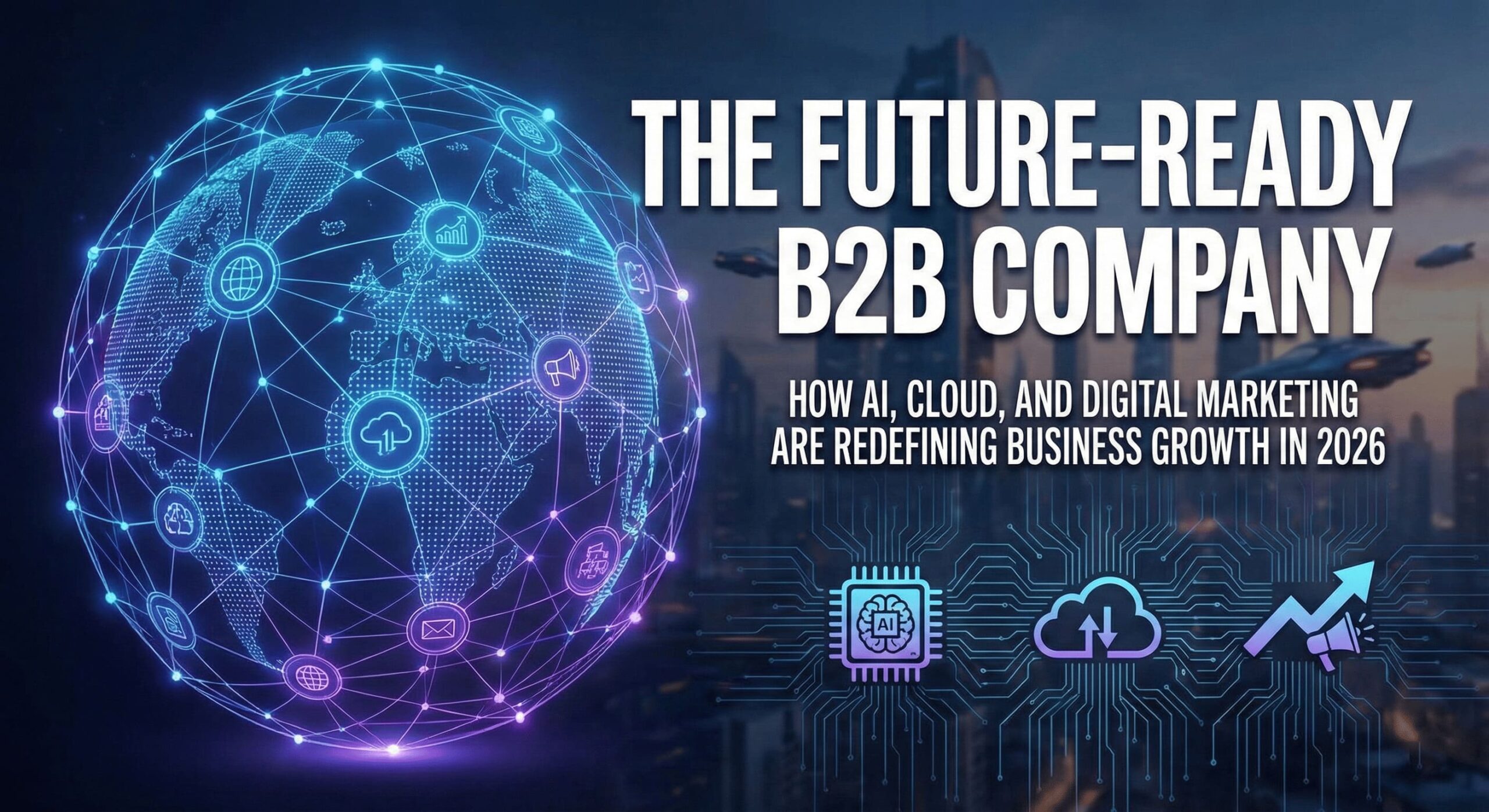
Digital marketing has also undergone a fundamental shift. In future-ready B2B companies, marketing is not a support function. It is a core revenue driver. SEO, content marketing, LinkedIn presence, and performance campaigns work together to attract, educate, and qualify buyers long before sales enters the conversation. The website becomes a conversion asset, not a brochure. Content becomes a trust-building and deal-accelerating tool, not just a traffic generator.
The real transformation happens when cloud, AI, and digital marketing stop working as separate initiatives and start operating as one integrated growth system. When marketing data flows directly into CRM, when AI continuously analyzes what is driving real revenue, and when leadership can see the full customer journey in one place, the business gains a level of control and predictability that traditional B2B models simply cannot offer.
At the same time, many companies struggle not because of technology, but because of legacy thinking. They are still organized around departments instead of customer journeys, and around activities instead of outcomes. This creates internal complexity that the customer eventually feels. In contrast, future-ready organizations are designed around speed, clarity, and alignment.
When companies successfully build this integrated growth engine, the impact is both strategic and measurable. Typically, they see improvements such as:
- Faster sales cycles, better lead quality, and higher conversion rates
- Lower customer acquisition costs and more predictable revenue growth
For CEOs and marketing leaders, the role in 2026 is not to choose tools, but to design the growth architecture of the business. The real question is no longer how to run better campaigns, but how to build a system that makes growth repeatable, scalable, and resilient.
At NXTidea, we work with B2B companies to do exactly this. Our focus is not on delivering isolated services, but on building integrated digital growth systems that align cloud infrastructure, AI-driven intelligence, and performance-focused marketing into one clear direction.
The future-ready B2B company will not be the one that works the hardest. It will be the one that adapts the fastest and executes with the most clarity. Over the next few years, the gap between companies that operate as connected, data-driven growth machines and those that rely on fragmented legacy setups will only widen. Digital transformation in B2B is no longer about staying competitive. It is about staying relevant.



ExoWatts
July 2, 2026 at 2:41 pmGreat content! Keep up the good work!