
Beyond Digital Transformation: Why the Real Change Is Not in Technology, but in How Businesses Think
For more than a decade, “digital transformation” has been one of the most used phrases in business. Almost every B2B company claims to be on a transformation journey. New software is purchased, new systems are implemented, and new dashboards are created. Yet, many of these organizations quietly admit something uncomfortable: despite all this investment, the business does not feel fundamentally different.
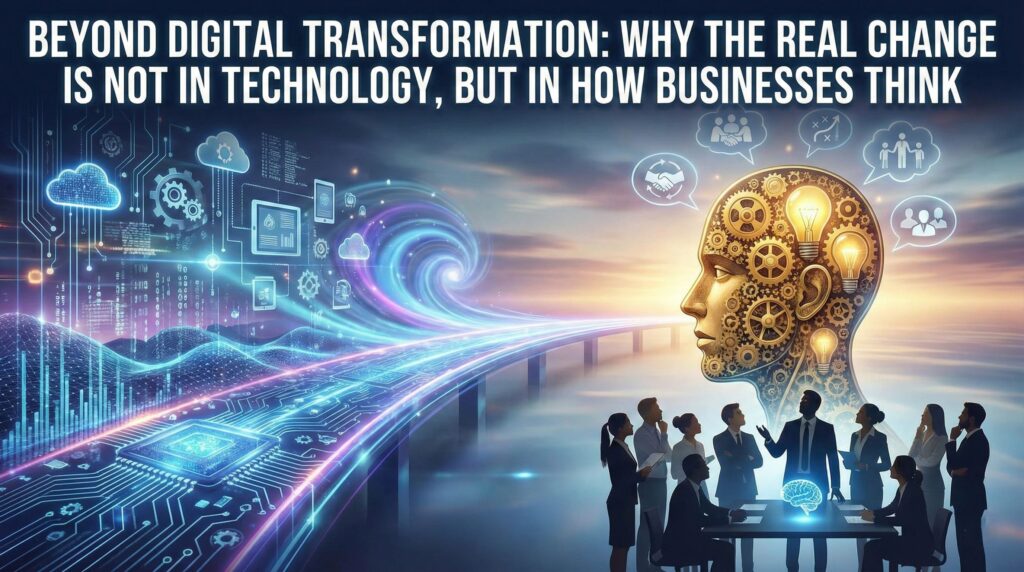
This is because digital transformation, as it is commonly practiced, is often treated like a renovation of the building instead of a redesign of how people live inside it.
As we explained in our pillar blog The Future-Ready B2B Company, modern enterprises are not built by adding tools. They are built by aligning cloud, AI, and digital systems into a unified growth engine. But even that engine cannot deliver results if the organization itself is not ready to run differently. This is why the future belongs not to companies that “do digital,” but to those that go beyond digital transformation.
To understand this, think of your business like a ship. Technology is the engine. But an engine alone does not decide the destination, the speed, or how well the crew works together. If the crew is not trained, the navigation is unclear, and the processes are broken, even the most powerful engine will not save the journey.
This is exactly what we see in many B2B transformations today. Companies buy modern CRM systems, cloud platforms, and automation tools, but still run their business with old habits, old structures, and old decision-making models. The result is frustration, low adoption, and disappointing ROI.
Real transformation happens when people, processes, and platforms change together. Not one by one. Not in isolation. Together.
In practical business terms, sustainable transformation always rests on three pillars:
- People must understand, trust, and use the new way of working
- Processes must be redesigned for speed, clarity, and accountability
- Platforms must connect the business into one intelligent system
When one of these is missing, the transformation looks good in presentations but fails in daily operations.
One of the most common reasons digital transformation fails is that companies treat it as an IT project instead of a business redesign. Leadership approves budgets, teams implement systems, and then everyone hopes that behavior will magically change. It rarely does. People continue to work in old ways, use workarounds, and fall back to Excel and WhatsApp because the underlying processes and incentives were never changed.
Another common failure is trying to transform everything at once. This creates confusion, resistance, and fatigue. The organization feels like it is under permanent construction, but nobody sees clear business benefits. The smarter companies treat transformation like modernizing an airport while flights are still taking off and landing. They do it in phases, with clear priorities, and with visible wins.
There is also a leadership problem that quietly kills many initiatives. Some leaders delegate transformation instead of owning it. But transformation is not a software upgrade. It is a change in how decisions are made, how performance is measured, and how accountability works. If leadership behavior does not change, the organization will not change either.
So what does a practical transformation roadmap look like for a B2B company?
It starts not with technology, but with clarity. Clarity about where the business wants to go, how it wants to compete, and what kind of organization it needs to become. Only after this should technology choices be made.
The next step is to redesign core processes around outcomes, not departments. Instead of asking how marketing works, how sales works, and how operations work, future-ready companies ask how a customer moves from first contact to long-term relationship, and then build systems and workflows around that journey.
Then comes platform unification. As described in The Future-Ready B2B Company, cloud becomes the foundation, AI becomes the intelligence layer, and digital systems become the execution engine. This is when data starts flowing, visibility improves, and decision-making becomes faster and more accurate.
But the most important work happens in parallel: changing how people work and how success is measured. If teams are still rewarded for local optimization instead of overall business impact, silos will remain, no matter how modern the systems are.
A good way to think about this is to imagine moving from a relay race to a football team. In a relay race, each department runs its part and passes the baton. In a modern business, everyone plays on the same field, towards the same goal, with the same scoreboard.
When transformation is done correctly, the impact goes far beyond efficiency. The organization becomes more responsive to the market, more confident in its decisions, and more capable of innovation. Instead of spending energy on coordination and firefighting, leadership spends more time on strategy and growth.
This is where transformation becomes a long-term value creation engine, not a one-time project.
As we see across industries, from manufacturing and distribution to B2B services and enterprise platforms, the companies that truly succeed are not the ones with the most software. They are the ones that redesign how they think, decide, and execute.
This is why the future of transformation is not digital. It is organizational.
And this brings us back to the core idea of the future-ready enterprise. As described in The Future-Ready B2B Company, technology is only powerful when it is aligned with strategy, structure, and leadership mindset. Without that alignment, even the best systems become expensive furniture.
In the end, going beyond digital transformation means building a company that can continuously evolve, not just complete a project. It means building an organization that is ready not only for today’s change, but for changes that have not even arrived yet.
The companies that win in the next decade will not be the ones that implemented the most tools. They will be the ones that built the most adaptable, most intelligent, and most learning organizations.
That is not a technology decision.
That is a leadership decision.